
Atacama Desert Trip
Inside Chile's Infamous Clothing Dump
Talk about an extremely polarizing place! The Atacama Desert has built its reputation on extremes — the DRIEST non-polar place on earth, salt flats that stretch to the horizon, and skies SO dark and clear that observatories from around the world have planted themselves here just to look up. It's a "trip of a lifetime" destination, for good reason.
But - you know I’ll find the ‘weird’ wherever I go… so an Atacama Desert trip today comes with a second, less glamorous storyline: mountains of discarded clothing, dumped illegally outside a city that most travelers have never heard of, which have turned this remote region into an unlikely symbol of the fast fashion crisis.
I went looking for that clothing dump myself on a recent trip through northern Chile, after a friend who lives there mentioned it - almost in passing. What I found — or almost didn't find — ended up reshaping how I think about this entire region & fast fashion. This guide is built from that experience: the research I did beforehand, the people I talked to there, and the parts of the Atacama that have nothing to do with clothing waste but are just as worth your time. It's what an actual Atacama Desert trip looks like when you go looking for the story underneath the postcard.
Planning an Atacama Desert Trip: What It Actually Involves
Most people planning an Atacama Desert trip are thinking about the postcard version: salt flats, geysers, flamingos, and a night sky so packed with stars it looks fake. The Atacama Desert sits in northern Chile, stretching along the Pacific coast and up into the Andes, and it's less a single destination than a massive region — the kind of place where you can stand on bone-dry, cracked earth in the morning and see snow-capped volcanoes by afternoon.
Ps- when I say bone-dry…I’m from Arizona… and it’s DRIER THERE. I didn’t know that was possible, but make sure you stay hydrated- check out my hydration tips!
San Pedro de Atacama is the town that makes all of this accessible. It's small — more dirt roads than paved ones, more adobe buildings than modern hotels — BUT it sits at the crossroads of nearly everything travelers come to the Desert to see. Tour operators here run daily trips out to the Tatio Geysers, the Salar de Atacama, and the various valle de formations scattered around the region, which is why almost every Atacama Desert trip itinerary starts and ends in this one town. Because much of the region sits at high altitude, San Pedro is also where most people acclimatize for a day or two before pushing further out.
Where Is The Atacama Desert?
Let’s get descriptive: The Atacama Desert runs along the northern edge of Chile, squeezed between the Pacific Ocean to the west and the Andes mountains to the east, stretching roughly from the Peruvian border down through the Antofagasta region. San Pedro de Atacama sits toward the eastern, inland side of the desert, close to the Bolivian and Argentine borders, at an elevation high enough that altitude sickness is a real consideration for visitors flying in from sea level. (I feel like a weather girl after describing that… but)
What makes the Atacama Desert so extreme — and so photogenic — is also what makes it so fragile. Some parts of the desert haven't recorded meaningful rainfall in living memory. That extreme dryness is part of why the landscape looks almost lunar in places, we always said it looked like Mars! It's also part of why the region has become a hub for astronomical research; there's barely enough moisture or light pollution to interfere with the night sky. But that same remoteness is exactly what's allowed the clothing waste problem to grow unchecked for years, far enough from Chile's population centers that almost no one was watching.
Atacama Desert Clothing Dump Location
The clothing dump that's made international headlines isn't in San Pedro de Atacama at all — it's several hundred miles northwest, near the coastal city of Iquique and the neighboring city of Alto Hospicio, in a stretch of the Atacama Desert most tourists NEVER pass through.
Iquique is home to one of South America's largest duty-free ports, and for decades it has been a major entry point for secondhand and unsold clothing - manufactured in places like China and Bangladesh, shipped in from Europe, Asia, and the U.S. — much of it originally donated to thrift stores like Goodwill before being baled up and resold internationally.
Iquique itself is worth pausing on before you even get near the dump site. El rincón de Cachuperto has THE BEST empanadas - ugh delicious! It's got real surf culture, go see Sergio at Vertical Surf Shop right in front of El Colegio, one of the heaviest and respected reef breaks in northern Chile- a shallow, barreling right that draws surfers from all over the country. I was staying in Iquique, but did NOT paddle out there- too heavy, it would harsh my mellow.
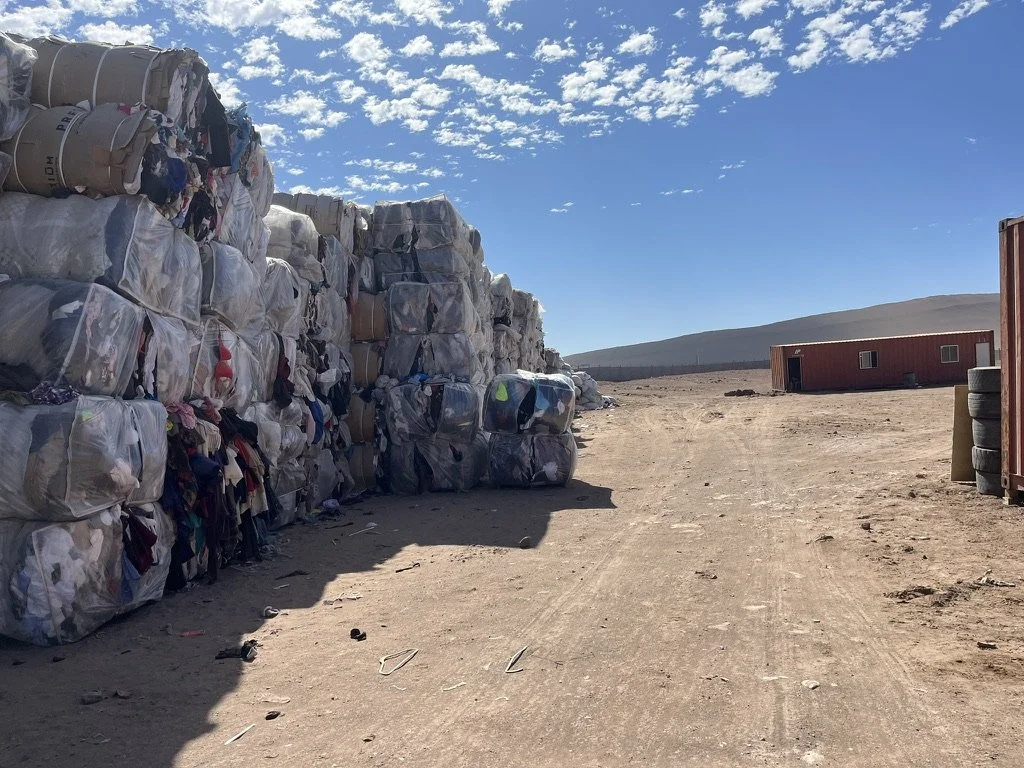
Locally, people sometimes call the area "la isla de ropas" — the island of clothes. Some of what arrives gets resold in Chile - people can buy packages of the clothes for a kilo or so, and you’ll see them selling clothing on the street. Then some of the clothes are exported elsewhere in Latin America, but a large share can't legally be sold, or is low-quality enough that no buyer wants it, and isn't accepted at municipal landfills because of the synthetic fibers and chemical treatments in the fabric. So it ends up dumped, informally and often illegally, in the open desert. There's no official marker for it, and it isn't listed on any tourist map. I only knew it existed because a friend brought it up almost as an aside, and I couldn't stop thinking about it after that. I mean, after living and manufacturing clothing in Asia, I had to see it.
What struck me most wasn't the scale of it, it was how random and specific everything was. Gear stamped with Yale's business school, sorority and fraternity shirts, pairs of Levi's with visibly botched printing, the kind of factory misprint that never should have left the production line. It's an odd feeling, standing in the driest desert on earth looking at a garment with a university logo from Connecticut on it, and realizing how far something has to travel — and how many hands it passes through — before it ends up discarded in the sand. The single thread of how we all effect each other - that's the part that's stuck with me more than any statistic about the quantity of clothes.
Why the Atacama Clothing Dump Exists?
Understanding why this happens starts with how much clothing the global fashion industry produces. Tens of thousands of tons arrive at the Iquique port every year, and a large share has essentially no resale value by the time it gets there — the leftover tail end of a fast fashion system built to produce far more than anyone will wear. It’s cheaper to produce in bulk, and cut your losses on what doesn’t sell.
Because much of it is synthetic and treated with dyes and chemical finishes, it doesn't biodegrade and can't be safely burned or buried. In a desert this dry, there's almost nothing to naturally break the material down — no rain, no humidity, no microbial activity. Clothes dumped here don't disappear; they sit, sometimes for years, occasionally catching fire and sending toxic smoke over nearby neighborhoods. Rats, dogs, all kinds of things make this clothing a home. It's less a story about one desert and more a visible symptom of how much the world overproduces and undervalues clothing everywhere.
We went in the fall — spring turning into winter down there, so it was actually cold, not the blazing heat you'd picture. The drive out from Iquique took about an hour, hour and a half, and we went midday.
The man we ended up talking to turned out to be the owner of the clothing operation itself, with that unmistakable wheeler-dealer energy the second he opened his mouth. He and my friend spoke in Spanish. The chilean dialect is difficult so it was hard for me to follow all of it. I asked my friend to ask him directly where the isla de ropas was. His answer, translated: "No. No. It doesn't exist." Flat, final, no room for follow-up. My friend tried to introduce me, and the guy dismissed me outright and kept talking like I wasn't there. Not twenty minutes later, we passed him again on the road — driving straight toward the exact spot he'd just told us didn't exist.
What we found when we got close wasn't something you drive into. It's essentially a narrow, two-lane corridor cut between sand dunes — tight, unmarked, and closer to skid row than a landmark, with nothing that made it feel like a place outsiders belonged. Especially, a blonde gringa…We got close enough to see it, decided it wasn't safe to go further, and turned around. This isn't a tourist attraction; it's a place you look at from above, on satellite imagery, and then leave alone.
For what it's worth, the guy we met wasn't connected to EcoFibra — a Chilean company that's been turning textile waste into housing insulation since 2018. I looked EcoFibra up afterward and it's a completely separate operation with its own founder.
How To Visit The Atacama Desert Clothing Dump Responsibly
The honest answer here is simple: you don't. This isn't a tourist attraction, there's no path to it, and it isn't a place outsiders can safely walk or drive into. If you're curious about it, here's how to actually approach it.
Don't Try to Go In Person
This is the real tip, not a formality. We got close enough to see it and turned around — there's no infrastructure that makes it safe for visitors. If a local tells you it's not accessible, believe them and stop there.
View It the Way Most People Actually See It — From Above
Satellite imagery is genuinely the best way to grasp the scale of this place — it's how researchers and journalists have documented it too. Pull up Google Maps' satellite view over Alto Hospicio if you want to see it for yourself, without putting anyone at risk.
Don't Expect — or Ask For — an Exact Address
Because the dumping is largely illegal and the piles shift, there's no fixed, publicly listed address anyone can hand you, and no legitimate guide should offer to walk you in. Treat any coordinates you find online as unreliable.
Remember People Live Nearby
Some of the area around the dump overlaps with genuinely difficult living conditions. Treat it the way you'd treat any place where people are dealing with poverty and hardship — with discretion, not as a photo backdrop.
Support the Recycling and Reuse Efforts Instead
Companies like EcoFibra, along with local designers and importers, are working to turn textile waste into insulation and other products. If you want to engage with this issue in a way that actually helps, support the groups doing that work — that's the version of "visiting" that does something.
How To Explore the Atacama Desert Beyond the Clothing Dump
Once the clothing dump story is out of your system, the rest of an Atacama Desert trip is, frankly, one of the most beautiful stretches of the planet.
Valle de la Luna
Just outside San Pedro de Atacama, Valle de la Luna earns its name — wind-carved rock formations, dry riverbeds, and dune ridges that genuinely look lunar, especially at sunset when the valley shifts through shades of red and gold. Most visitors time their visit for sunset. Get directions
The Tatio Geysers
Getting to the Tatio geysers means a very early start — most tours leave San Pedro around 4 a.m. to arrive before sunrise, when the geothermal field is most active and the steam is most dramatic against the cold air. It sits at extremely high altitude, well above 14,000 feet, so acclimatize in San Pedro for a day or two first. Get directions
Salar de Atacama
The Salar de Atacama is the largest salt flat in Chile, home to flamingo populations that wade through shallow, mineral-rich lagoons against white salt crust and distant volcanoes. It's also one of the world's major sources of lithium — an unexpectedly modern layer on an ancient landscape. Get directions
The Night Sky
Because of the altitude, dry air, and minimal light pollution, the Atacama night sky is one of the clearest in the world — part of why major observatories are based here. Even without a telescope, stepping outside in San Pedro after dark delivers more stars than most people have ever seen at once. Several operators run stargazing excursions with an astronomer on hand.
Laguna Cejar and the Hidden Lagoons
A short drive from San Pedro, Laguna Cejar is a hyper-saline lagoon where the water is so dense with salt that floating is effortless — a strange, Dead Sea-like experience against a stark desert backdrop. Get directions
An Atacama Desert trip can be both things at once — the otherworldly landscapes that put this region on every traveler's list, and a clear-eyed look at what most itineraries skip entirely. Seeing the clothing dump didn't make the rest of the trip less beautiful; if anything, it made the salt flats and the night sky feel more worth protecting. If you're planning your own trip through northern Chile: go with someone who knows the area, ask questions before you assume, and don't expect Google Maps to have all the answers — sometimes you need the satellite view.